- Jan 14
The Cosmic Classroom: What the Planets Teach Us About Human Consciousness
- Jagatsevak
- Vedic Astrology Lessons
Have you ever gazed at the night sky and felt a profound connection to the cosmos? Ancient wisdom traditions, particularly Jyotiṣa (Vedic Astrology), tell us that the planets (called Grahas) aren't just distant celestial bodies, but profound energetic influences intimately connected to our consciousness, our psychological evolution, and our journey towards self-realization.
Join me as we journey from the fiery heart of our solar system outwards, exploring how the physical ordering of the Sun and the classical planets, including the pivotal Lunar Nodes, mirrors the profound principles of Vedanta, Yogic philosophy, human development, and the eternal quest for "Who Am I?"
Each planet, in its unique position, poses a fundamental question, guiding our growth from ego-formation to ultimate liberation. We'll explore these questions from two perspectives: the outward gaze (how the planet influences our interaction with the external world and others) and the inward gaze (how it shapes our inner experience and self-perception).
The Sun (Sūrya): The Soul's Core & The Eternal Question
Location: The blazing center of our solar system, the source of all light and life.
The Principle: In Vedanta, the Sun embodies Brahman and Atman – the ultimate reality and our true, pure consciousness. In Yoga, it's Purusha, the silent witness. It's the life force, Prana, that animates all.
Human Connection: The Sun represents our innate, unconditioned self, the spark of divine within, and the foundational sense of our identity.
The Sun Asks
Looking Outward: "How do I project my authentic self into the world? How do I lead and inspire?"
Looking Inward: "What is my true nature? Who am I, at my core essence, beyond all roles?"
This is the primal inquiry, urging us to look beyond labels and roles to our essence.

Mercury (Budha): The Emerging Mind & The Quest for Understanding
Location: The closest planet to the Sun, orbiting swiftly.
The Principle: Mercury embodies Buddhi (discriminating intellect) and Manas (the active mind). It's the swift processing of consciousness's light into thought.
Human Connection: This is where our cognitive abilities, language, and the capacity to make sense of the world emerge. Mercury is the ego's first tool for categorization and expression.
Mercury Asks
Looking Outward: "How do I communicate my thoughts effectively? How do I learn from my environment?"
Looking Inward: "How do I understand and organize my own thoughts? What can I learn about my inner workings?"
This question marks the ego's emerging capacity to articulate and process its nascent self-awareness.
Venus (Śukra): Desire, Connection & The Allure of Experience
Location: The second planet from the Sun, radiant and beautiful.
The Principle: Venus governs Kama (desire, attraction), Prema (love), and the captivating power of Māyā (illusion).
Human Connection: It represents the development of our emotional responses, our capacity for attachment, empathy, and our pursuit of pleasure and connection. The ego here learns to define itself in relation to others.
Venus Asks
Looking Outward: "How do I connect and harmonize with others and the world? What beauty and pleasure do I seek externally?"
Looking Inward: "What do I truly value and desire within myself? How do I cultivate inner harmony and self-love?"
This probes the ego's engagement with the external world through attraction, relationships, and the pursuit of happiness.

Earth (Bhūmi) & The Moon (Chandra): Embodiment, Emotion & Subjective Reality
Location: Our home, with the Moon as its constant companion, intimately linked to our lived experience.
The Principle (Earth): Our planet is Karma Bhūmi, the realm where our actions manifest. It represents our Annamaya Kośa (physical body) and the Jagrat Avastha (waking state).
The Principle (Moon): The Moon pre-eminently represents Manas (the mind), Chitta (the storehouse of impressions), our emotions, and subconscious patterns. It's the ever-changing face of Prakṛti that houses consciousness.
Human Connection (Earth & Moon): This is where the ego fully grounds itself in a physical form (Earth) and develops its inner, subjective, emotional world (Moon). It highlights our needs for security, nurturing, and emotional comfort. The Moon's constant motion around Earth mirrors the daily fluctuations of our mind and emotions.
Earth Asks
Looking Outward: "How do I act and manifest my existence in this physical reality? What is my purpose in this embodied life?"
This is the question of karma and dharma in the manifest world.
Looking Inward: "How do I ground myself in my body? What is the felt experience of being alive?"
The Moon Asks
Looking Outward: "How do I respond emotionally to my environment and others? How do I seek comfort and belonging?"
Looking Inward: "How do I feel and perceive my inner world? How do my emotions shape my experience and influence my subconscious?"
This addresses the ego's subjective experience, memory, and emotional processing—crucial for self-awareness on the path to liberation.
Mars (Maṅgala): Willpower, Action & Asserting the Self
Location: Beyond the Earth-Moon system, fiery and dynamic.
The Principle: Mars embodies Kriya Śakti (the power of action) and the drive to overcome inertia.
Human Connection: This planet signifies the development of our independent will, the desire to act, establish boundaries, and achieve goals. It's the ego's assertion and sense of efficacy in the world.
Mars Asks
Looking Outward: "How do I assert myself and achieve my goals in the world? What am I willing to fight for?"
This question confronts the ego's drive for autonomy, courage, and its ability to manifest its will.
Looking Inward: "How do I direct my inner energy and willpower? What motivates me to act from within?"

Rāhu & Ketu: The Karmic Crossroads & The Unfolding Path
Location: These are not physical planets, but mathematical points (the North and South Lunar Nodes) where the Moon's orbit intersects the Sun's apparent path. They represent a pivotal karmic axis, active especially after the personal ego (Sun to Mars) has taken shape, and before the more expansive lessons of Jupiter and Saturn.
Rāhu (North Lunar Node): The Unquenchable Desire & Future Growth
The Principle: Represents Akaśic desires from past lives, an insatiable thirst for material experience, ambition, and innovation. It pushes us towards what we must learn and integrate.
Human Connection: Rāhu highlights areas of intense desire, sometimes obsession, where we are compelled to expand and gain new experiences, often pushing us beyond our comfort zones.
Rāhu Asks
Looking Outward: "What do I intensely desire to experience and acquire from the external world? Where must I expand and grow beyond my comfort zone in life?"
This illuminates the ego's powerful, often compulsive, drives towards future experiences, born of past life leanings.
Looking Inward: "What deep, unfulfilled desires reside within me? What new aspects of myself am I compelled to explore?"
Ketu (South Lunar Node): Past Mastery, Detachment & Spiritual Release
The Principle: Represents past life attainments, innate wisdom, and the urge towards detachment and surrender. It's associated with Moksha and the dissolution of the ego, pointing to what we need to release.
Human Connection: Ketu signifies areas where we feel naturally adept but also potentially detached or apathetic. It's where the ego needs to surrender control and let go of fixed notions, fostering spiritual yearning.
Ketu Asks
Looking Outward: "What external experiences or attachments do I need to release or detach from? Where am I naturally indifferent to worldly pursuits?"
Looking Inward: "What do I need to release and surrender from within to find liberation? Where does my past mastery now require inner detachment and acceptance?"
This challenges the ego to let go of what it clings to, even its own achievements, for deeper spiritual freedom.
Jupiter (Guru): Wisdom, Dharma & The Search for Meaning
Location: The largest planet, majestic and encompassing, ruling over a vast domain.
The Principle: Jupiter embodies Dharma (righteousness, cosmic law), Jñana (true knowledge), and the Guru Tattva (principle of the spiritual teacher). It's predominantly Sattvic (pure).
Human Connection: This planet signifies the search for meaning, purpose, and understanding of universal laws. The ego here begins to identify with ideals and principles far beyond its immediate gratification.
Jupiter Asks
Looking Outward: "How can I align myself with universal truth and wisdom in the world? What higher purpose guides my actions and beliefs?"
Looking Inward: "What is the deeper meaning and purpose of my inner life? How do I cultivate wisdom and faith within myself?"
This question elevates the ego's perspective beyond personal desires towards a universal, ethical, and spiritual framework.
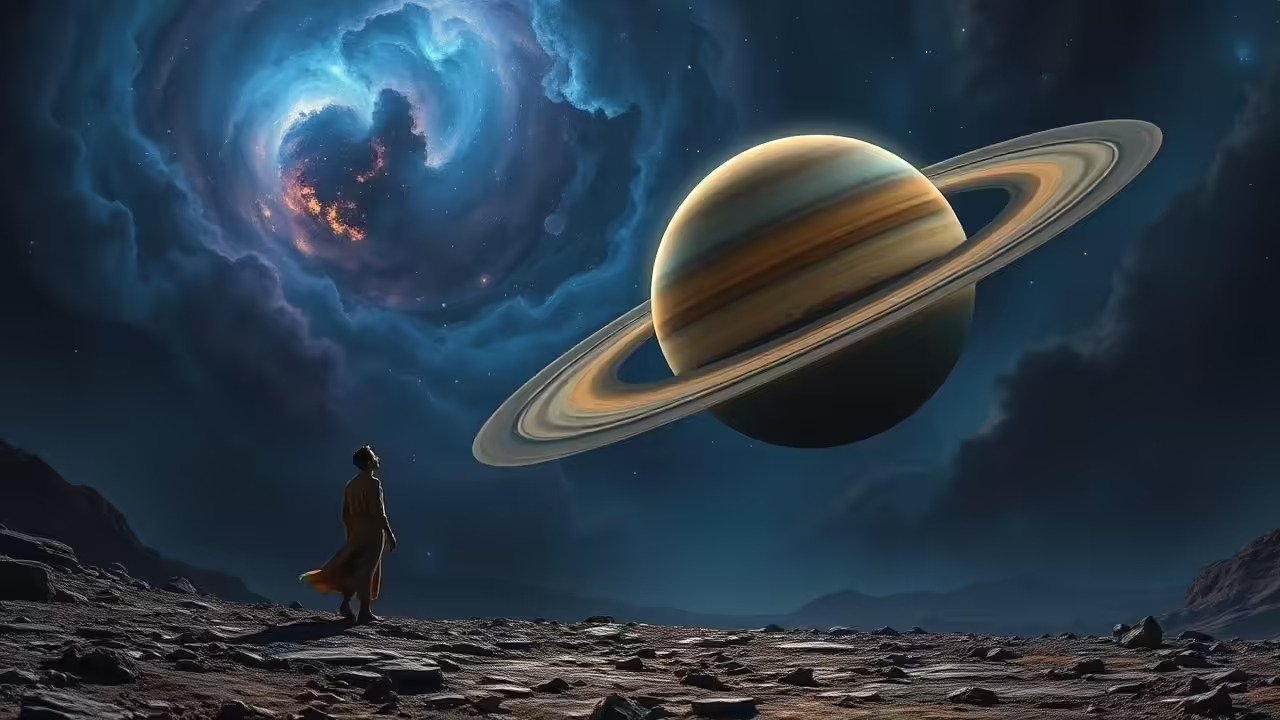
Saturn (Śani): Structure, Discipline & The Path to Liberation
Location: The outermost classical planet, slow-moving, with rings symbolizing boundaries.
The Principle: Saturn is the ultimate planet of Karma, Vairagya (detachment), Kāla (time), and ultimately, Mokṣa (liberation). It forces us to confront Dukha (suffering) to gain profound wisdom.
Human Connection: Saturn represents the development of our superego, self-discipline, and the capacity for responsibility, enduring hardship, and confronting mortality. It's where the ego is humbled and gains hard-won wisdom.
Saturn Asks
Looking Outward: "What are my true responsibilities and how do I master myself within the constraints of time and karma in the external world?"
Looking Inward: "How do I transform my suffering into wisdom and attain true inner liberation? How do I embrace discipline and detachment to refine my consciousness?"
This question forces the ego to confront reality, accept limits, embody discipline, and ultimately transcend its conditioned nature for genuine freedom, bringing the journey to its culmination.
The Cosmic Blueprint of Evolutionary Consciousness: Outward and Inward
The physical ordering of the planets, from the radiant Sun to the disciplined Saturn, offers us a profound cosmological blueprint for the human psyche's journey. It's a progression from the initial, undifferentiated consciousness (Sun) through the intricate layers of ego development—our minds, emotions, desires, actions, and karmic patterns (Mercury, Venus, Earth/Moon, Mars, Rāhu, Ketu).
This individual journey then expands into the search for higher wisdom (Jupiter) and culminates in the rigorous discipline, detachment, and ultimate liberation (Saturn) that allows us to shed the false self and truly realize our inherent connection to the Ātman, the pure consciousness of the Sun.
By understanding both the outward and inward questions posed by each graha, we gain a deeper insight into the multifaceted nature of our own development. The cosmos, indeed, is our greatest classroom, constantly prompting us to inquire, grow, and ultimately, know ourselves.