
- Feb 5
Building Your Jyotiṣa Foundations: The Benefits of Learning the Houses First
- Jagatsevak
- Vedic Astrology Lessons
- 0 comments
Students of Jyotiṣa encounter many technical components—grahas (planets), rāśīs (signs), nakṣatras (lunar mansions), and others—but without first understanding the function of the houses, these elements often lack coherent context.
Think of the birth chart as a blueprint of your life's journey through the “planet earth school”, and the houses as the twelve distinct “classrooms”. Each classroom has a specific purpose—a science lab for experiments, a library for quiet study. If you don't first understand the function of each classroom, it's impossible to make sense of the teachers and classmates (the planets), or the themes and environments (the signs) unique to each classroom.
This is why establishing a solid foundation in the role and significance of the houses is one of the main keys to unlocking meaningful, accurate insights in Jyotiṣa.
The Value of a Bhāva-First Approach
Without a firm grasp of the houses, it’s easy to misinterpret the core message of a chart. Here’s why starting with the bhāvas is so powerful:
Provides a Life Context:
The houses represent the fields of experience in your life—relationships, career, family, health, and more. They give you the real-world context for every planetary placement. For example, if you know the 7th house governs marriage and partnerships, you can more easily interpret what the planet Mars signifies there. Without that context, Mars's energy could seem random or out of place.
Avoids Misinterpretation:
Jumping straight into grahas and rāśīs can lead to fragmented and incorrect readings. You might learn that Saturn is a planet of hardship, but if Saturn is placed in the 11th house (gains and networks), it doesn't necessarily mean hardship. Instead, depending on the specific chart, it might signify a slow, disciplined approach to achieving your goals and building lasting friendships. The house provides the specific area of life where the planet's energy will manifest.
Enhances Synthesis and Analysis:
Jyotiṣa is a system of synthesis, not just a collection of separate rules. By learning the Bhāva Axes—such as the 1–7 axis of self and relationships, or the 4–10 axis of home and career—you can understand how different areas of life are interconnected. This wholistic perspective is essential for accurate chart analysis and for understanding the beautiful, complex story of a person's life.
Grounds You in Foundational Concepts:
The different categories of houses (which we'll explore below) provide a philosophical and thematic layer to the chart. Learning these early helps you understand the karmic and spiritual significance of different life areas, preventing your practice from becoming a repetitive or mechanistic exercise.
Bhāva Categories and Classifications
Learning the houses is more than memorising their individual meanings and significations; it’s also about understanding the groups they belong to and interact with in the course of a person’s life. These categories are fundamental to deeper chart analysis and reveal the underlying purpose and dynamics of each house.
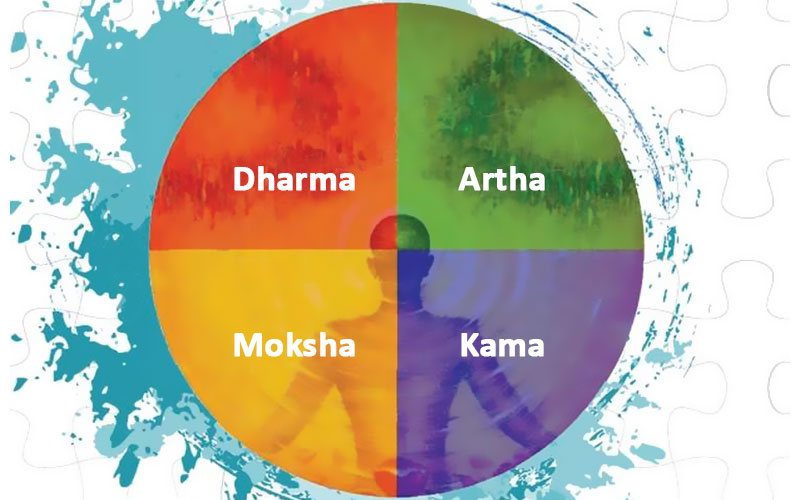
Puruṣārthas (Aims of Human Life):
These houses are grouped according to the four aims of human existence.
Dharma (Houses 1, 5, 9 – Fire 🔥):
Purpose, life path, and spiritual duty. These houses relate to identity, creativity, and higher wisdom.
Artha (Houses 2, 6, 10 – Earth 🌍):
Resources, security, and material wealth. These houses govern earned income, daily routine, and career.
Kāma (Houses 3, 7, 11 – Air 💨):
Desires, relationships, and aspirations. These houses relate to communication, partnership, and community.
Mokṣa (Houses 4, 8, 12 – Water 💧):
Liberation, intuition, and spiritual release. These houses govern emotional foundations, transformation, and ultimate freedom.
Some Other Important Bhāva Classifications Include:
Kendras (Houses 1, 4, 7, 10):
The pillars of the chart, representing the most important and stable areas of life. These are the "action" houses that define the core of a person's existence: self, home, relationships, and work in the world.
Trikoṇas (Houses 1, 5, 9):
The "trinity" of houses related to luck, fortune, and spirituality. They are highly auspicious and signify natural talent, creativity, and blessings.
Duḥsthānas (Houses 6, 8, 12):
The houses of difficulty, struggle, and challenge. They represent illness, debt, chronic problems, transformation, and loss. While challenging, they are crucial for spiritual growth and self-discovery.
Upacaya (Houses 3, 6, 10, 11):
The "growing" or "improving" houses. Planets placed here tend to show an increase in their effects over time, often through effort and hard work.
Apacaya (Houses 1, 2, 4, 5, 7, 8, 9, 12):
Apacaya means "decrease," "diminution," or “loss”. These houses signify areas of life that, over time, may lose their central importance or require a shift in focus.
Maraka (Houses 2, 7):
So-called “killer” houses. These houses can signify challenges to health or vitality, especially if their lords are afflicted. They are related to the end of things, whether it be a phase of life or life itself.

Bhāva Kārakatvas (House Significators)
Each bhāva has a rich set of significations that paint a detailed picture of that area of life. Understanding these helps you read a chart like an unfolding story. Of the literally hundreds of kārakatvas for each house, the following are essential for beginning students to commit to memory.
1st House: The Self – The physical body, personality, vitality
2nd House: Resources – Family, wealth, and speech
3rd House: Effort – Siblings, communication, and courage
4th House: Home – Mother, home, and emotional foundation
5th House: Creativity – Children, intelligence, and passions
6th House: Service & Health – Debt, disease, and daily routine
7th House: Relationships – Spouse, business partners, and contracts
8th House: Transformation – Shared resources, death, and secrets
9th House: Wisdom – Father, guru, and higher education
10th House: Career – Public life, reputation, and authority (also father)
11th House: Goals – Gains, aspirations, and social networks
12th House: Liberation – Foreign lands, spirituality, and losses
Putting It All Together: Practical Examples
Let's look at how this foundational knowledge comes to life.
Interpreting a Planet in a Bhāva:
Imagine you see Venus, the planet of love and harmony, in the 6th house. A beginner who only knows about planets might be confused. But a student with a solid bhāva foundation would know the 6th house relates to service and overcoming obstacles. They may then interpret this as someone who finds love and harmony through acts of service (e.g., a nurse who finds fulfilment in caring for others), or a person who uses their diplomacy to resolve disputes.
Understanding a Life Event:
A person experiences a significant family crisis (4th house), followed by a major career event (10th house). A student who understands the 4–10 axis can see these seemingly separate events as interconnected. The emotional and foundational shift from the 4th house may have led to the transformation in their public life and career, showcasing the dynamic interplay of the bhāvas.
Analysing a Person's Motivation:
Someone is highly focused on their career (10th house) and their finances (2nd house), but struggles with relationships (7th house) and spiritual pursuits (9th house). By understanding the person’s chart karmic emphasis on Artha (2, 6, 10) and Kāma (3, 7, 11) houses, a student can see that this person’s focus is currently on the material and resources aspects of life. Their desires are not being fulfilled in relationships, which points to an area of potential imbalance and a focal point for future personal growth.
A Final Thought
Starting with the houses gives you the confidence to interpret a chart with a deep, intuitive understanding of the human experience. It’s one of the most valuable first steps you can take in your journey with the beautiful and fascinating world of Jyotiṣa. As you reflect on your own life's journey, consider which of these “classrooms” you've spent the most time in, and which ones you're still working to understand. This practice of introspection is how we move from simply learning about astrology to living its wisdom.
May you live in the home of your heart and may that heart by home to your living. 🕉️